Showing posts with label Roberts Camera. Show all posts

Sunday, November 4, 2012

Nikon D600 - "Say Hello To My Little Friend"


Well today, I brought home a new member of my family.  I'm now the owner of a Nikon D600 FX DSLR.  I've been shooting Nikon since I was a wee lad, but other than 35mm film, this is my first full frame, "FX" DSLR. 
 
I really like shooting with a cropped, "DX", sensor and is part of my muscle memory.   I've used a Nikon D100, D200 and now my trusty Nikon D300s.  Love 'em. I've gotten used to the 1.5x (approximate) cropped factor from my Nikkor lenses.  However, at the same time I've started to find that it's a drawback in the studio.  Also, for street photography I like the shorter focal length and my 50mm is a bit too long for this use, so I have to use a 35mm. 
 
The Real Thing
It was only a matter of time before I bought a full frame sensor.  It wasn't a question of if, but what type of DSLR.  Obviously, I wanted to stick to Nikon primarily because I have a full range of Nikkor and Tokina lenses.  I researched the Nikon D4, D3s, D3x, & D800.  I even looked at an older Nikon D700.  Finally, the D600 soon after it was introduced. 
 
Look, I don't make my living as a photographer, so I couldn't justify spending the $$$ for any of the big 3: D4, D3s & D3x.  I liked everything about the D800 ergonomically, but I really didn't need the 36.3 megapixels nor did I want to spend the $2,999 (more or less).  Finally, the D700 was tempting.  The price was perfect, but it doesn't have video.  The D600 fit the bill for me. 
 
The D600 came in at $2,099 without a lens (didn't need one), has a solid 24.3 megapixel (twice what I get from my D300s), excellent ISO range, a compact ergonomic design, AND it's an FX body.  The big challenge for me is the feature layout.  The layout is more like a Nikon D7000 versus the D700 / D800.  I'm really comfortable with the button and control layout of my D300s.  It's going to take me awhile to figure out how to change ISO, speed, AF zones, etc.  Minor inconvenience.  I will hang onto my D300s as a backup and for the cropped factor (although it's getting well past it's "used by" date in terms of the number of shutter activations I've put through it).  I'll have to become bi-lingual in camera layout.
 
One thing I'm interested in testing is how my lenses respond on the full frame.  I know they will work perfecto, but more along the lines of how my lens selection will change using a full frame.  It will be fun using my 50mm as a real 50mm.  Same goes for my AF-S 24-70mm f/2.8, AF-S 70-200mm f/2.8, etc. 
 
I will give the D600 a go this week and upcoming weekend.  I probably won't post a review because there are so many already out there.  However, if you are so inclined her are the D600 specs.  OK, so where did I leave that manual, I've got some reading to do!!  In closing I want to give props to Roberts Camera's north store.  They are always easy to work with, don't try to up-sell when it's not wanted or needed, and they have competitive prices. 

Tuesday, September 11, 2012

Yes Master

My wife bought me a really nice birthday gift yesterday, OK, OK, I bought it myself.  I purchased a Sekonic L-358 FlashMaster light meter.  Excellent. 

Say Hello To My Little Friend
Think of a light meter the same way as when our Government votes to spend money to improve training for our military.  Not as sexy as authorizing a new fighter, but just as if not more important.  Same with the light meter.  It would have been sexier to buy (sorry, for my wife to buy for my birthday) a new Nikon D800 or a new set of Elinchrom lights, but I feel I needed the light meter to get the lighting control I desire.

I photograph more than 50% of my sessions in studio recently.  While in studio I use various studio lights and speedlights.  The challenge I often have especially when using seamless backgrounds is getting the lighting spot on.  I know, I know I can fix it in post, or I can shoot a series of test shots, but I would prefer getting it right in camera early.  Also, I've recently ventured back to film as part of my photographic adventure.  Funny thing, most of the film cameras I have or that I've recently purchased don't have light meters.  I can use an iPhone app or Sunny 16, but this allows me to nail the exposure pronto.

Also, kudos to Roberts Camera in Indianapolis.  I like to shop local and I enjoy Roberts.  They have a knowledgeable staff, their store is well equipped and their staff are just cool.  However, their prices tend to be on the high side especially when compared to B&H.  I went to Roberts on a whim at lunch yesterday and guess what, the Sekonic was the SAME price as from B&H.  The extra $$ I paid for tax is more than made up by not having to hassle with the signature delivery.  A win-win.

Anyway, I'm extremely happy with my new tool in the photographic toolbox, and now I'm itchy to go out and give it a workout.  Stay tuned.

Thursday, October 27, 2011

Nikon 1 System Lenses

A few weeks ago I posted a blog post about Nikon's new Interchangeable Lens Compact, ILC, mirrorless camera system the V1 & J1.  I talked about he lenses that would be available, but had few specifics.

Here is a blog post from the camera store I normally visit, Roberts Camera, in Indianapolis that highlights the new lenses.

One comment, with the camera on the new iPhone 4s, point & shoot cameras need to potentially rethink their strategy especially in the higher price range.  One such strategy is the ILC to keep them relevant in the P&S category.  

Enjoy

Roberts Camera Blog - Nikon 1 System Lenses

Sunday, June 7, 2009

Nikkor 35mm of Sweetness

Nikkor recently introduced it's new AF-S DX 35mm f/1.8G DX lens. I've been anxiously waiting to purchase one since they came out, but alas they have been hard to get. Found one this weekend at Roberts in downtown Indianapolis. Sweet...

This 50mm equivalent lens on a DX sized sensor is uber fast with a maximum aperture of f/1.8. I took it out for a spin as soon as I purchased it. So far, I'm extremely happy with the lens. Here it is:


The lens (mounted on my Nikon D200) has ultra smooth, lightning quick focus. I was amazed at how fast I could set my camera speed which is very useful to capture fast moving action or in bright settings. I took it out on an extremely sunny day and took the following shot. Tack sharp.


For this image I set my Nikon D200 at F/1.8 in aperture priority. ISO at 100 and speed clocked at 1/2500.

I also brought the lens out at night to see how it operated in low light. I was not disappointed. Mounted on a tripod I was able to get a super sharp night shot at F/10, ISO 100 and shutter speed at 15 seconds. Also in aperture priority. Here is the shot.


I also played around with DOF using the F/1.8 to it's fullest affect. Amazing. I'll post a few of those shots later.

Bottomline, at only $200 I think the new Nikkor 35mm F/1.8 (50mm equivalent on a DX camera) is a must for any photographer's kit, whether you are an amateur or a pro. It's compact, it's fast, it's lightweight but sturdy, and affordable. Me Like!

OK, pick up your camera and shoot away. I do!!

Tuesday, May 26, 2009

Nice Legs!!

I mentioned in my post yesterday one piece of kit any photographer needs is a good set of legs ... I mean a good tripod. Like most things in photography the type of photos you take will point you to the right tripod for your needs. However, one bit of advice, don't be cheap. A good tripod will last for years and will help turn average images into much better photos. This is completely subjective, but expect to pay $250 or more for a full tripod.

If you take low light photography, macro or portrait photography I think a tripod is a must. Really, the only photo setting where I have not used a tripod is when I am doing my hand held street photography.

The 2 key advantages in my book to using a good tripod is 1) image sharpness is improved and 2) you can take lower ISO images in low light. To take tack sharp photos at night or in low light settings, or whenever you need to slow down your shutter speed below 1/50 of a second and don't want blur use a tripod. I've read that you can do away with a tripod if you have an uber fast lens or a good piece of glass with VR (i.e. Nikkor's 18-200mm VR). However, in my experience with low ISO even with fast glass or VR a tripod adds sharpness.

One hint, if you use a lens with vibration reduction (VR) on a tripod, turn off the VR.

I used to have a really inexpensive tripod that weighed a ton. Sure it worked, but man was it a pain. It took forever to set up and tended to drift with anything other than a prime lens mounted on my camera. It was useless and was just stupid (note, "stupid" is not a technical photographic term). I ultimately threw it away. I replaced it with a moderately priced (all in less than $300) Manfrotto component tripod. I purchased the legs and heads seperately. I would recommend that you purchase the legs seperately from the head like I did because it gives you more flexibility to select the head that matches your shooting style. Also if you need to replace a head you don't need to pitch the legs.

I purchased a Manfrotto 190XProB leg set. This is a very light weight black finished aluminum set of legs. The legs adjust with quick locking clamps and have friction tension at the head joint. It weighs almost nothing, is extremely portable, quick to set up, and handles ALL of my existing lenses up to a Tamron F/2.8 70-200mm lens. The legs can basically be set in any configuration.


Also after research and the advice of Roberts Camera I purchased 2 heads. I bought a heavy duty Manfrotto 804RC2 Basic Pan Tilt 3 way photo head. This head is used almost exclusively when I'm out at night or taking a set shot where I don't need to pan or move the camera very quickly or where I want precise settings. It's very sturdy.


For everyday use I purchased a Manfrotto 486RC2 basic ball head. This is a light weight head, and while it works fine, I'm not convinced it's right for my use. It handles all my lens, but it's a bit of a pain to adjust precisely. Also, you need to keep your hand on your lens or camera when loosing the adjustment nob. When you loosen the adjustment knob your camera free floats. Unless you have your hand on your camera or lens it will fall forward to the stops. Not very handy. However, for quick action (i.e. sports) or when you want to pan it works fine. I would rate it a solid 6 out of 10 for my use.


I keep this head on my tripod as a default. I change out to the 3-way head if I know I'm going to need precise settings. However, in hindsight I probably should have purchased a Manfrotto 322RC2, Heavy Duty Grip ball head instead of the 486RC2. This head has a handle with a quick release hand trigger. I've tried this a few times in my local photo shop and it would suit me better. Again, where did I leave that Christmas list?


Bottomline, I'm real happy with the Manfrotto kit, and I'm sure you will find there are other manufactures that make fine equipment and other Manfrotto leg / heads that will suit your specific needs. However, remember my caveat, leave your $50 WalMart tripod at home and get yourself a nice set of legs. I take mine with me all the time and they are always in the truck of my car.

If you want to check out the specs of the tripod go to www.manfrotto.com You'll find everything you need. BTW, I purchased my tripod and got good advice at the good folks at Roberts Camera in downtown Indianapolis.

OK, don't sit there reading this blog, pick up your camera, run outside and take some photos. I do!

Monday, April 20, 2009

Fast Glass

OK, I decided to finally purchase some faster lenses!

Since I switched to digital about 5 years ago I've used the traditional advance amateur lenses. I've relied on my Nikkor 18-70mm DX, 18-135mm DX and a recently purchased 70-300mm ED VR (replacing a non-VR version). I also use a Tokina 10-17mm AT-X DX Fisheye and a Tokina SD 12-24 AT-X DX wide angle lense. Except for a prime Nikkor F/1.8 50mm lens, none of my lenses are very fast. Most have F/3.5 at the fast end. I like to take lots of handheld street scene photograph and late night photoshoots. With my lenses I struggle with blur and/or noise unless I use a tripod.

I finally decided to buy a couple of F/2.8 lenses. I've been drooling over the F/2.8 Nikkor lenses, and have researched them for some time. Honestly, if it wasn't for the cost I would have only Nikkor lenses. Since I'm only an advance amateur I couldn't justify approximately $1,700 for a new Nikkor 70-200mm VR F/2.8, and the $1,000 plus cost of a shorter zoom lens with the same speed.

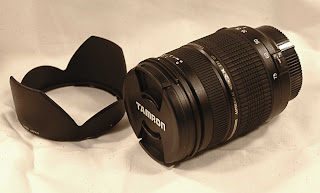
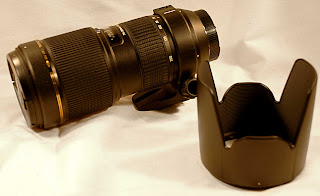
After much research and consideration I decided to purchase a Tamron SP AF70-200mm F/2.8 DI LD Macro, and an SP AF 28-75mm F2.8 XR Di LD Macro. Both were more in my price range, although I realize "you get what you pay for". So far I'm happy with the purchase. I purchased both at Roberts Camera. Both lenses combined were approximately $500 less than the Nikkor AF 70-200mm VR F/2.8. Again, if money wasn't an issue I would be a proud owner of two new Nikkors.


Here is the AF28-75mm lens. This will become my "keep on the camera" lens that I will use most of the time. I will regularly interchange this with my Nikkor 18-135mm lens for most of my shots. What I like about this lens is the F/2.8 speed, it's clean lines and it's sturdy build. Also, it has a slightly longer zoom range out to 75mm, although not a huge plus, but nice. I took some test shots and so far I like this lens.
The lens weighs in at 510g with a filter size of 67mm. The lens comes with a Bayonet type lens hood because the lens is IF.

The SP AF70-200mm F/2.8 Di LD Macro is a beast. It weighs in at about 1150g and is very sturdy. Its not as elegant as it's Nikkor higher end brother. The BIGGEST drawback is that it does not have VR, but please note my comment above about price. I took several test shots at different focal lengths and the lens shake isn't as bad as I expected. With the faster speed I am confident that I can use it in most hand held situations. I normally use a tripod with all my night photoshoots so this won't be an issue.

The lens comes with a huge bayonet type lens hood and a 77mm filter size. I really like the feel and the look of this lens when mounted. Also, if I ever get hassled in any of my late night photoshoots I can use the lens as a club...


So far, I'm really happy with these 2 lenses and I'll post a few shots using the lenses in the near future.

Hats off to Roberts Camera for helping me with these purchases. I knew what I was looking for and what I needed, so the sales guy let me do my thing. He provided help when I had a technical question and when I wanted to try out all the other F/2.8 lenses including the Nikkors.